
Fire and illusion
Beauty and grace in Rishikesh, India
Spiritual hype in a faraway land
Tapovan near Rishikesh, the Birthplace of Yoga. Taxis and tuk-tuks swerve around cows calmly lying on the street, unphased by the chaotic traffic around them. Caravans of Westerners slowly walk on the side of the road. Drenched by the warm showers of the Monsoon rain, they wear tight yoga clothes in bursting neon colours — retro synth-wave fashion in faraway Uttarakhand. The Yoga disciples walk barefoot; little streams from the monsoon rain flow around their ankles.
Locals do not walk barefoot except for a few old sadhus in orange robes with grey hair who turned their backs on their previous lives. Some found a new profession in professing to Western seekers, while others seem at peace with themselves. Youth convoys, black caravans of pumpin’ motorcycles with orange Hanuman flags, take up the road. They blast techno music that thumps through the valley.
Western commercialism created a parallel universe of flashing lights in this holy place. Tapovan has Yoga school signs galore, mixed with Ayurveda clinics and hippie-run hostels. Only when walking deeper into the back alleys, away from the tourist hustle and bustle, do we see the picturesque side of this place: distant sounds of a puja, a group of school children playing in the garden of an ashram, a shrine on the corner of the road. Noise and peace are all around.
In the flow of time
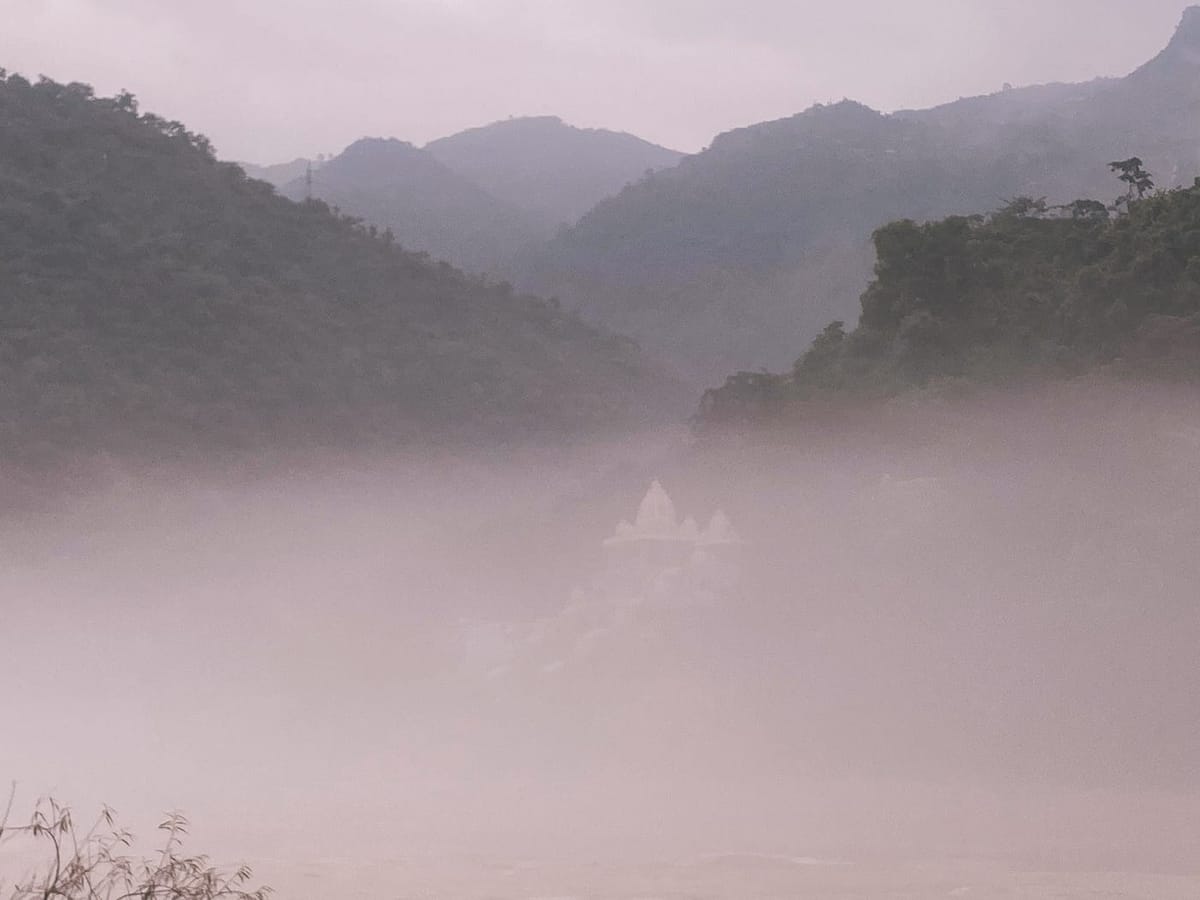
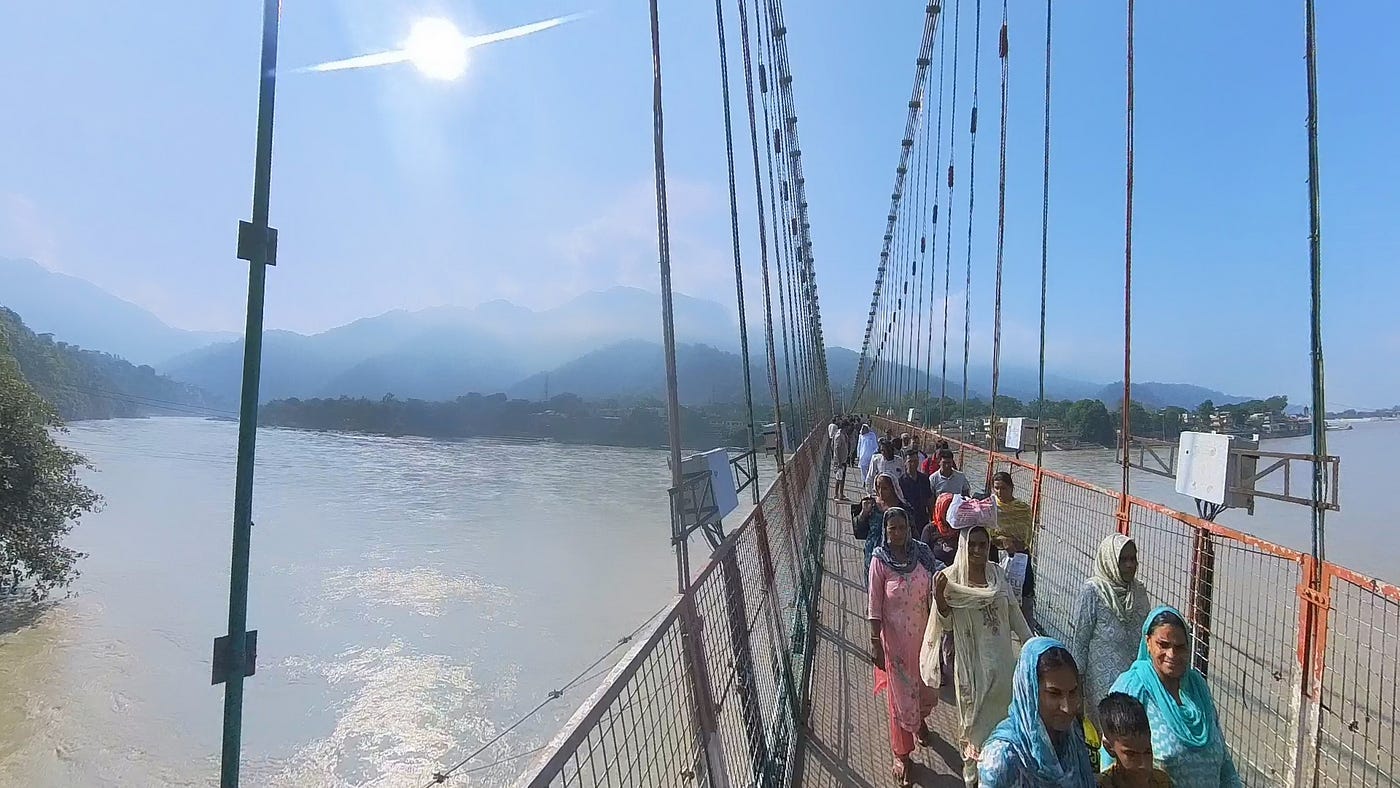
We descend to the ghat, steps leading to the Ganges River, Flumen Aeternum. The rain has stopped, and the air is hot and humid. Majestic Ganga-ji flows into the valley, its river banks lined with ashrams, temples, golden tridents and Shiva statues. As the river’s cool mountain water mixes with the hot, humid air, dense fog arises above the river’s surface. The valley looks like it is floating above the clouds, a wisp of pastel blue candy cotton in the jungle.
Stepping into the river, I feel chilly, light-as-air water flowing around my ankles. Fine mountain sand streams between my toes. Ganga-ji’s water is clear as if suspended in time, adrift across aeons of existence.
Rishikesh, the gateway to the Himalayas, is named after the Sanskrit word Hrishikesha, an epithet of Lord Vishnu meaning “Lord of the Senses” or “He under whose control the senses subsist.” In the West, Rishikesh gained fame when the Beatles visited it in 1968, during the heyday of the Hippy movement.
We are not here for Yoga. For us, Rishikesh is the beginning of a longer journey around India, a country with diverse religious traditions united in one human quality: Seeking.
A play of illusions
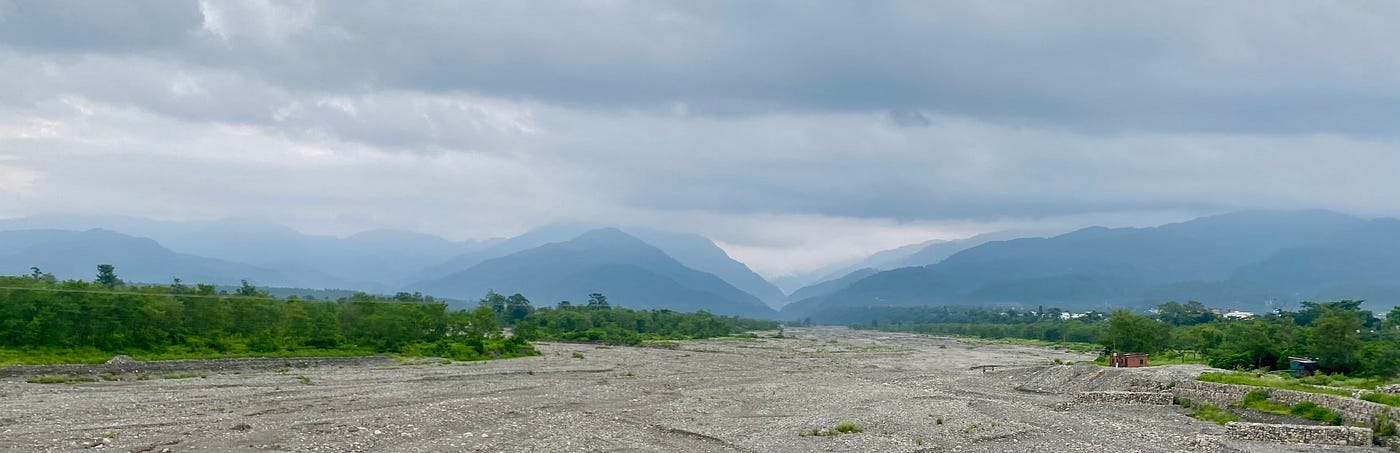
A hidden staircase leads us through tightly built houses on the side of a cliff. The stairs are lined with stalls and shops. We walk past fragrant spices, hemp clothing, religious statues, and malas made of rudraksha beads. Arriving on top of the cliff, a monk invites us into his Shiva temple. As the orange sun disc cuts into Rishikesh’s grey, hazy mountains, the pandit performs a puja for us and wraps a red and yellow wristband around our wrists, blessing us.
I did not think much of it then, but several months later, I still wear this wristband. Our travel in India is a fading memory, like a vivid dream, yet the wristband remains present in the here and now. It anchors me in the moment, as if writing these last few words were a distant memory. Intuitively, this is the play of Maya.
The ultimate liberalism
We meet fellow travellers at our hostel; many share profound life stories that brought them to Rishikesh. Listening to them, I cannot help but remember my childhood in East Germany during the GDR. In those years, people’s minds were formed into working-class atheists; their minds chiselled like marble communist statues; socialism was a quasi-religion.
Yet, people behind the Iron Curtain did not grow up in a spiritual void. Humans cannot live without meaning and hope; when neither exists, we create it. The absence of an official religious language and belief system led some people to search for their truth.
A seeker and inspiration to many, Andrei Tarkovsky was a master of capturing a sense of grace and beauty in the world. The movie director transcended the suffocating, materialist thinking of his time. His autobiography, The Mirror, is a profoundly spiritual journey into his memories and dreams, where suffering, love, and beauty mingle with the divine.
The Mirror is shot from a first-person perspective, a stream of human consciousness. In one scene, we observe a burning barn. Fire is one of the primal elements. This picture is a fragment of our collective memories of intergenerational trauma, fear, and awe. It represents the purification that precedes transformation and a new beginning. In one scene, the actors watch a burning barn in stoic contemplation, a moment of divine surrender, moving yet frozen in memory and time.
With the fall of the socialist regime and uprooted from religious belonging, we discovered new thinking. No matter the type of country and government we live in, finding one’s true faith is the ultimate liberalism.
A flash mob descends on the mountain temple
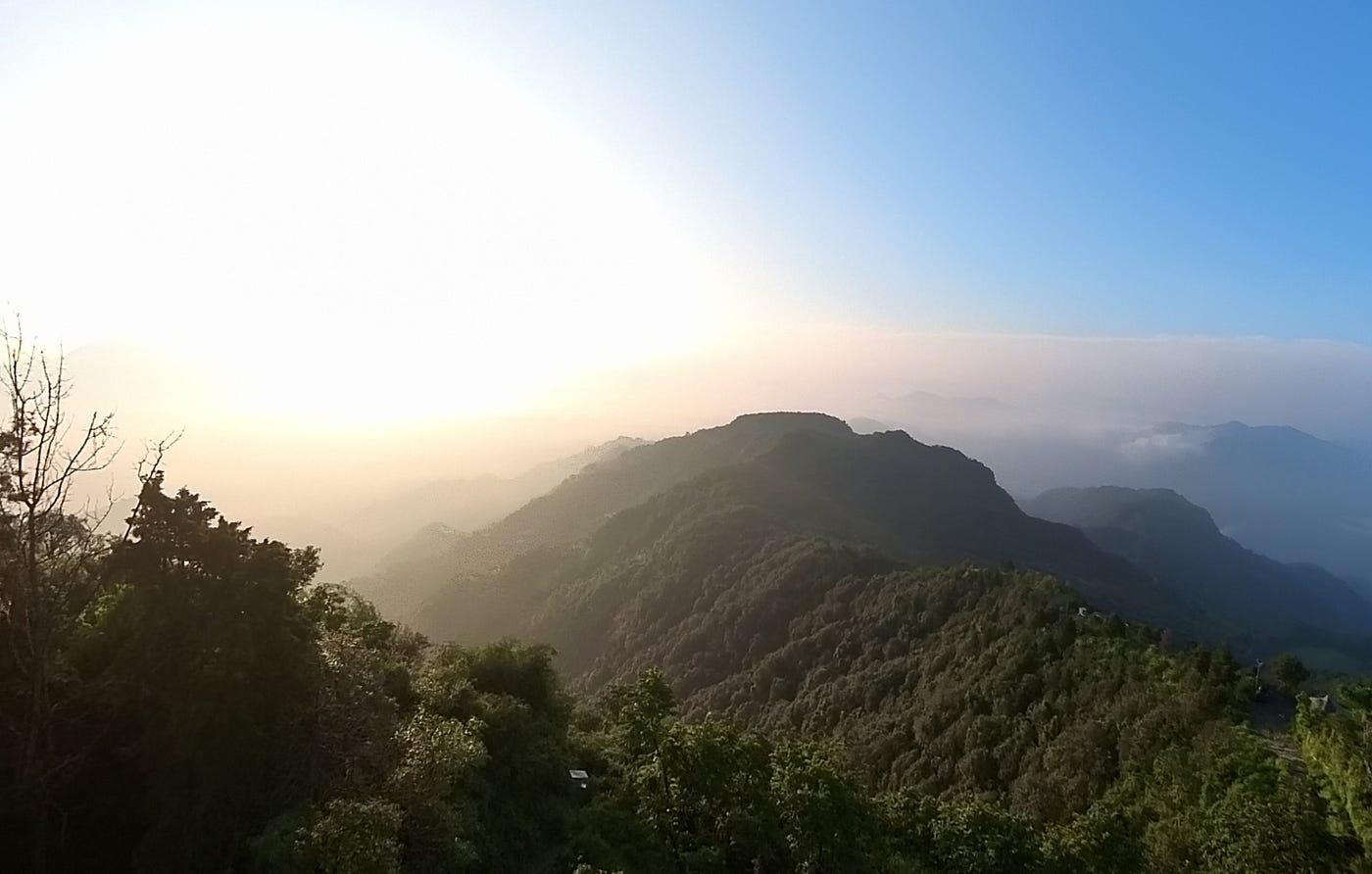
Back in Rishikesh, on a dark, early morning, our cab driver swivels around mountain curves. It is sunrise, and we hurry towards Kunjapuri Temple, a temple on a mountain.
We arrive at the parking lot near the peak and walk the stairs upward towards the temple. The sun rises behind the top edge of the stairs, illuminating a deep blue sky above us. A crowd is already gathered around the temple; we are late.
Freshly-baked Western Yoga students show off asanas for the ‘Gram’, posing in front of a majestic mountain silhouette. A group of tourists dances in a circle as if it were a flash mob; they motion others to join in. The stalls around the temple are buzzing with coffee, spicy samosas, and ceremonial items. A few people climb across the safety barrier on the side of the temple to escape the crowd and find space to meditate facing the rising sun. Looking for grace and beauty is not easy, especially when you seek where everyone else is already looking.
This must be a daily spectacle for the few locals, the Brahmin priest, and the traders. We buy a few ceremonial items and join the queue for the puja. After a brief blessing, we wait for the crowds to subside and take our time to explore the temple.
As we head down the stairs and return to the parking lot, we discover our taxi has gone. We are lucky to hitch a ride with a bus from a local yoga shala — the last vehicle to leave the parking lot for the one-hour journey back into the valley.
The school’s teacher is in his late 20s, and unlike many in the area, he is a local and grew up in Rishikesh. He is excited to share his views about Yoga and India’s political landscape. Like many people we meet on this trip, he personifies India as growing in confidence and prosperity. He gives us a breakdown of the different Tapovan schools, separating the genuine from the commercial ones. There will be differing opinions on what defines genuine yoga instruction, but we had no reason to doubt him. We make an endearing connection with a helpful stranger who wants nothing in return.
Engulfed by fire and water
We have always been fascinated by images of fire rituals near Ganga-ji. We decide to ride to Haridwar, one of the largest ghats in India. Along the drive, we pass miles after miles of hotels with pilgrims.
We are familiar with temple customs and wear traditional Indian clothes for this occasion. We blend right into the crowd. Occasionally, people in the audience curiously glance at us. Seeing a Westerner in traditional Indian clothes might feel touristy to some. However, because we are respectful, the staff treats us very kindly.
A pandit waves us over and asks us to sit closer to Ganga-ji. The crowd fills with thousands of pilgrims from near and far. During the puja, people are invited to join the priest standing in the river’s water. We offer floating lamps (diyas) to Mother Ganga as the Brahmin cites mantras and prayers. Then, we sit in the crowd and observe the pandits in awe as they chant mantras and invoke prayers. The entire crowd echoes the prayers’ words. It is electrifying.
As the sun sets, the two-hour ritual culminates in the fire ceremony. Acharyas ignite aarti thalis, which are large multi-tiered oil lamps. Accompanied by chants and mantras, practitioners move their oil lamps in circular motion. The flames are fed by swirling the lamps in the air, tongues of fire stretching out and then breaking away in the hot summer wind.
We are invited forward and move close to the fire. We now stand in the middle of the crowd, knee-deep in Ganga-ji. Around us are flames; it is hot. The crowd closes in, drawn to the fire for purification. The heat and energy pass right through us. The sound of drums and bells enraptures us in a timeless moment. We are being carried away like a fragment of eternity between fire and water.
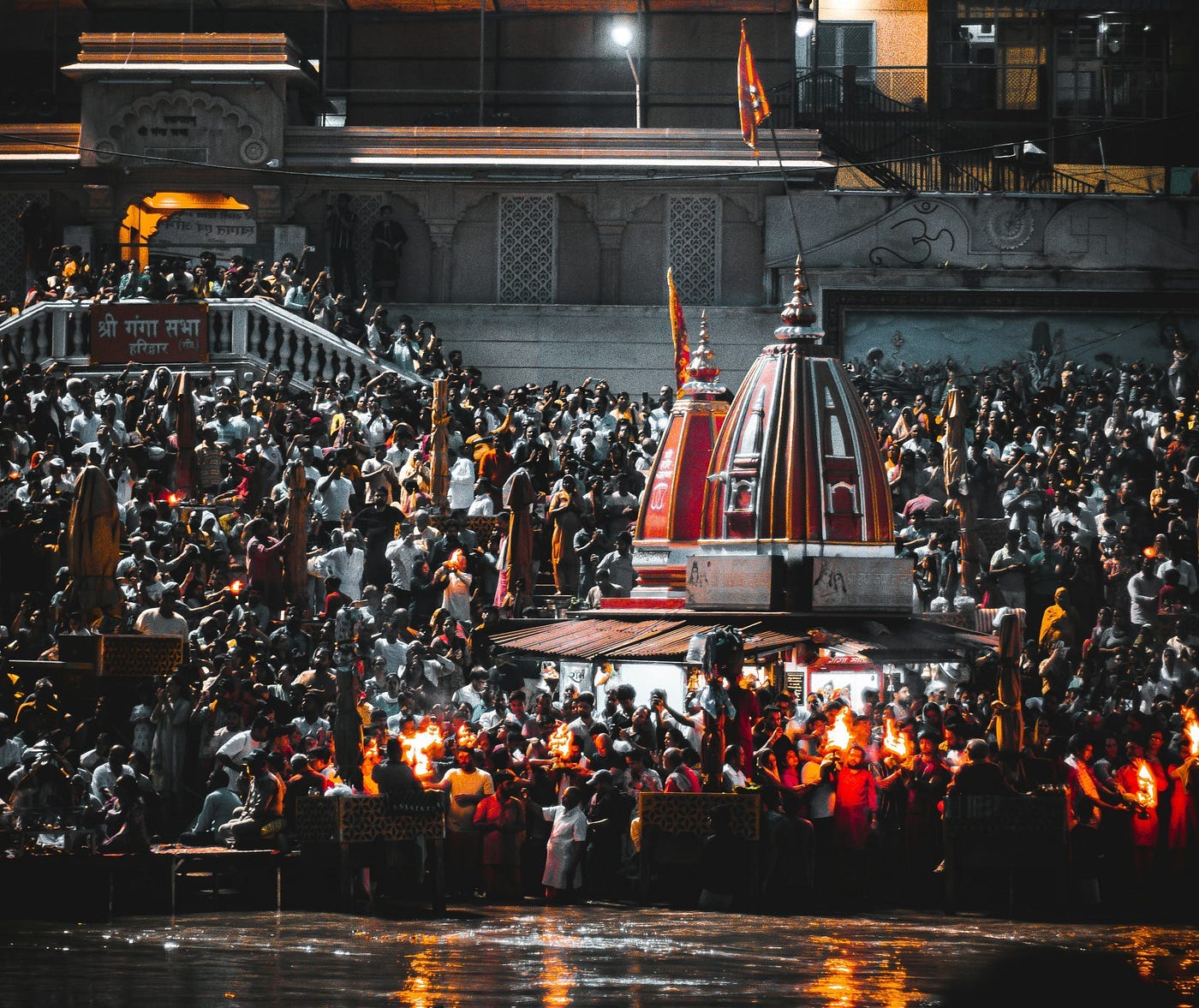
We are in awe of the luminous event. During our ride home, chaos and traffic noise are shifting into the background of my consciousness. The ceremony feels profound, and I cannot understand how it had such an impact on us.
The word ‘ignite’ and the Vedic God of fire ‘Agni’ are derived from the same Indo-European root. The oldest Veda, the Rigveda, begins by praising Agni. Fire is a means of communication with the divine, and Agni is the mediator between humans and Gods.
The aim of art is to prepare a person for death, to plough and harrow his soul, rendering it capable of turning to good. — Andrei Tarkovsky